Listen. Mumble. Master.


How Toddlers Learn to Talk: 6 Speech Principles Backed by Research
Your toddler points at the window and says “bir!” You smile and answer, “Yes, a bird! A little bird.” A few days later, you hear “bird” on its own, clear as anything. It can feel like magic. It isn’t. It’s a handful of simple principles working together, and you are already using some of them.
Researchers who study how toddlers learn to talk keep finding the same patterns. Children learn words best from people who respond to them. They remember words better when they say them out loud. And short, calm practice spread across days beats one long session.
In this guide, you’ll find six speech principles for kids, the research behind each one, and simple ways to use them at home in a few minutes a day. No degree, no strict schedule, no pressure.
The short answer: Toddlers learn to talk by hearing words many times in everyday moments, trying them out loud, and getting a warm response from the people around them. Six speech principles help most: respond to your child, let them say words out loud, model words slowly and clearly, add only a few new words at a time, keep practice short and spread across days, and keep it free of pressure.
How Toddlers Learn to Talk: The Big Picture
Talking starts long before the first word. Babies listen, babble and copy the rhythm of the voices around them. Most say a first word around their first birthday (more on that in our guide to when babies say their first word). Then words arrive faster, especially in the second and third years.
Three things drive that growth:
- Hearing words often, in real moments. Children need to hear a word many times, in many situations, before they understand and use it. Bath time, snacks and play all count.
- Trying words themselves. Saying a word, even unclearly, is practice for both memory and the mouth. “Nana” is a real step toward “banana”.
- A warm response. When you answer, smile or repeat the word back, your child learns that talking works. That makes them want to try again.
Every child moves at their own pace. If you’re wondering what’s typical, see how many words an 18-month-old says. The principles below work at every stage, from first words to long, tricky ones.
6 Speech Principles for Kids, Backed by Research
These six speech principles come from research on how children learn words and how speech therapists help them practice. Each one is simple to use at home.
1. The responsiveness principle: toddlers learn from people who respond
Toddlers learn new words best when the person talking responds to what they do. In one study, children aged 24 to 30 months learned new words in a live conversation or a video chat that responded to them. When the same video simply played, whatever they did, they learned nothing (Roseberry, Hirsh-Pasek & Golinkoff, 2014).
At home: follow your child’s lead. Talk about what they’re looking at, and answer their sounds and words as if they’re taking part in a conversation. They are.
2. The production principle: saying words out loud helps them stick
Words are easier to remember when you say them, not just hear them. Researchers call this the production effect. Five-year-olds remembered pictured objects better when they named them out loud than when they only looked or listened (Icht & Mama, 2015). Older children show the same effect when reading words aloud (Pritchard et al., 2020).
At home: invite your child to say the word with you, even softly. A gentle “mumble” counts. Never insist; an invitation works better than a demand.
3. The clear model principle: slow, clear speech is easier to copy
When you say a word slowly and clearly, your child hears every part of it. Speech therapists often ask parents to slow their own talking for this reason. In a small study of children with cerebral palsy whose speech was quite hard to understand, speaking more slowly made them noticeably easier to understand (Sakash et al., 2020). Children with milder difficulties gained less, so think of slow speech as a clearer model, not a cure.
At home: play “turtle talk”. Say a word as slowly as a turtle, then at normal speed. For long words, clap the beats, as in our guide to multisyllabic words.
4. The small-steps principle: a few new words at a time
Young minds can only hold a few new things at once. Adults keep about three to four items in working memory, and children keep fewer: in one set of studies, 7- to 9-year-olds held about one and a half to two (Cowan, 2017). Toddlers hold fewer still.
At home: pick two or three new words for the day and mix them with words your child already knows. Familiar words build confidence; new words build vocabulary.
5. The spacing principle: short practice, spread across days
A little practice often beats a lot at once. The principles of motor learning used in speech therapy show that practice spread over time supports long-term learning (Maas et al., 2008, summarized here). In a study with 5- to 7-year-olds, children who had one science lesson a day for four days learned more, and still remembered more a week later, than children who had all four lessons in one day (Vlach & Sandhofer, 2012).
At home: aim for five calm minutes a day, not one long session on the weekend. Stop while it’s still fun.
6. The low-pressure principle: effort, not perfection
Language grows best in relaxed, enjoyable moments. Children often don’t say a new word right away, and that’s normal. Silence doesn’t mean they aren’t learning (Hanen Centre).
At home: if your child says “nana”, don’t ask them to say it properly. Say it back clearly, “Yes, banana!”, smile and move on. Praise the try, not the result.
A Five-Minute Day Built on These Principles
You don’t need extra time. You need a few small moments you already have. Here’s how the six principles fit into an ordinary day:
- Breakfast (1 minute): offer a choice, “Banana or toast?”, and wait. Responsiveness, low pressure.
- Getting dressed (1 minute): name two new words, like “zipper” and “sleeve”, alongside ones your child knows. Small steps.
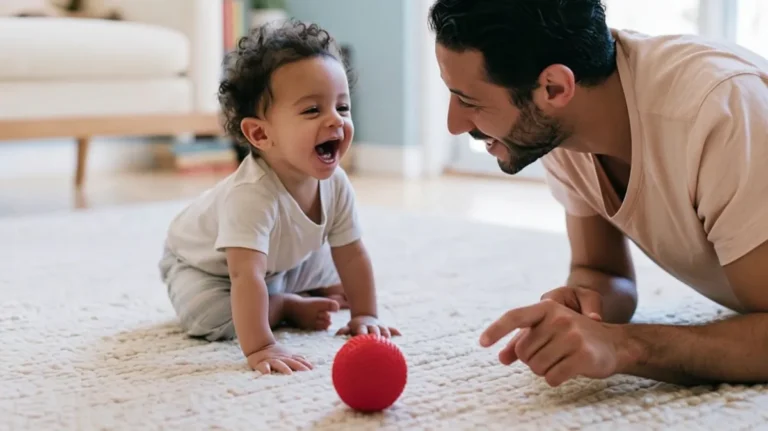
- Play (1–2 minutes): turtle talk with a favorite toy’s name, slowly, then fast, then just right. Clear model, production.
- Bath (1 minute): say the day’s new words again while you wash. Spacing.
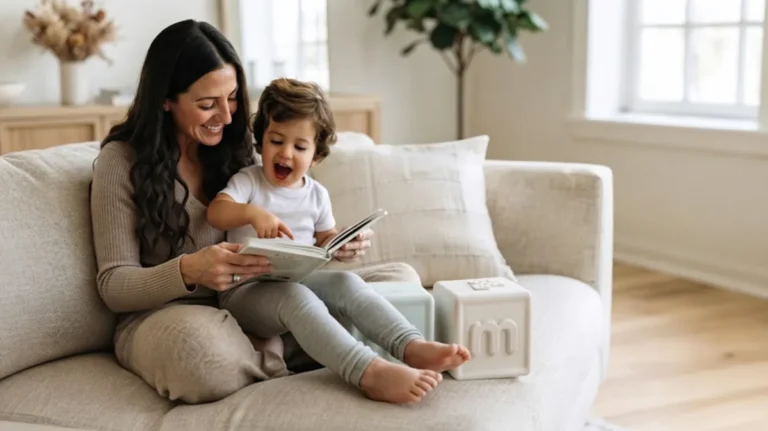
- Bedtime book (1 minute): pause before a familiar word and let your child fill it in. Production, responsiveness.
For more activities by age, see our guide to speech practice at home.
What to Avoid
A few common habits work against these speech principles, even with the best intentions:
- “Say it properly.” Asking for a perfect repeat turns a happy moment into a test. Model the word back instead.
- Filling every silence. Count to five in your head after a question. Many toddlers need a few extra seconds to find a word.
- Long drills. Twenty minutes that end in tears teach your child that practice is stressful. Five happy minutes do more.
- Background video. Words from a screen that doesn’t respond teach far less than words from you. If you use a screen, pick one your child talks back to, and sit with them.
- Too many new words at once. Ten new words in a row is a lot for a small brain. Two or three is plenty.
How Mumblet Uses These Speech Principles
We built Mumblet around these six principles, so a few calm minutes on a screen follow the same rules as good practice at home. Listen. Mumble. Master.
| Speech principle | How it shows up in Mumblet |
|---|---|
| Responsiveness | Mumblet waits for your child to say the word and then responds. Nothing plays on its own. You sit together, so your child gets your response too. |
| Production | Every card invites your child to say the word out loud with the Mumble button. Listening alone is never the goal. |
| Clear model | Tap the turtle to hear the word slowly, then say it at a turtle’s pace. |
| Small steps | Each deck is grouped by age and theme, and every round is just 10 cards. |
| Spacing | Rounds take about five minutes, made for a little practice every day. |
| Low pressure | No timers, no flashing lights, no loud rewards. Each round ends on a calm note. |
An honest note: Mumblet itself hasn’t been tested in a research study. It’s built on the principles above, which have been. It’s a calm practice companion for families, and it doesn’t replace a speech-language pathologist.
Try it today: the free starter deck is free forever, with no account needed.
When to Talk to a Speech Therapist
These principles support every child, but they don’t replace a professional check. The American Speech-Language-Hearing Association lists signs worth asking about (ASHA, via Handy Handouts):
| Age | Worth asking about if your child… |
|---|---|
| 19 months–2 years | Says only a few words |
| 19 months–3 years | Doesn’t combine words into short sentences |
| 2–3 years | Is hard to understand, even for family; often misses early sounds like p, b, m, h, w |
| 3–4 years | Is hard for other people to understand; often misses sounds like k, g, f, t, d, n |
Also ask if your child seems frustrated when talking, often repeats or gets stuck on sounds, or seems not to hear well. Your pediatrician or a speech-language pathologist can tell you whether to wait or get support. Asking early is never a mistake.
Frequently Asked Questions
How do toddlers learn to talk?
Toddlers learn to talk by hearing words many times in everyday moments, trying them out loud and getting a warm response. Responsive conversation, slow clear models and short daily practice help most.
What are speech principles for kids?
Speech principles for kids are research-based guidelines for helping children learn and say words. Six of the most useful: respond to your child, encourage saying words out loud, model words slowly, add a few new words at a time, practice briefly and often, and keep it pressure-free.
Are these speech principles backed by research?
Yes. Each principle in this guide links to published research or guidance from speech and language experts. The studies are listed in the sources below.
How long should we practice each day?
About five minutes a day, spread across moments you already have, like meals and bath time. Short and regular works better than long and rare.
Is screen time bad for a toddler’s speech?
It depends on the type. Video that plays regardless of what your child does teaches very few words. Tools that wait for your child, respond and invite them to talk, used together with you, follow the same principles as good practice at home.
Should I correct my toddler’s words?
No need. Say the word back clearly and warmly, like “Yes, banana!”, and move on. Your child hears the right version without feeling corrected.
The next time your toddler says “bir” and you answer “Yes, a bird!”, you’ll know exactly why it works. Respond, invite, slow down, keep it small, keep it short, keep it kind.
Every clear word starts as a mumble.
Sources
- Roseberry, S., Hirsh-Pasek, K., & Golinkoff, R. M. (2014). Skype me! Socially contingent interactions help toddlers learn language. Child Development, 85(3), 956–970.
- Icht, M., & Mama, Y. (2015). The production effect in memory: A prominent mnemonic in children. Journal of Child Language, 42(5), 1102–1124.
- Pritchard, V. E., Heron-Delaney, M., Malone, S. A., & MacLeod, C. M. (2020). The production effect improves memory in 7- to 10-year-old children. Child Development, 91(3), 901–913.
- Sakash, A., Mahr, T. J., Natzke, P. E. M., & Hustad, K. C. (2020). Effects of rate manipulation on intelligibility in children with cerebral palsy. American Journal of Speech-Language Pathology, 29, 127–141.
- Cowan, N. (2017). Mental objects in working memory: Development of basic capacity or of cognitive completion? Advances in Child Development and Behavior, 81–104.
- Maas, E., et al. (2008). Principles of motor learning in treatment of motor speech disorders. American Journal of Speech-Language Pathology, 17(3), 277–298. Summary in McCubbin (2019), Western University.
- Vlach, H. A., & Sandhofer, C. M. (2012). Distributing learning over time: The spacing effect in children’s acquisition and generalization of science concepts. Child Development, 83(4), 1137–1144.
- The Hanen Centre. How children learn new words (without being taught).
- American Speech-Language-Hearing Association, Identify the Signs, as summarized by Handy Handouts.
This article is for general information and doesn’t replace advice from a pediatrician or speech-language pathologist.