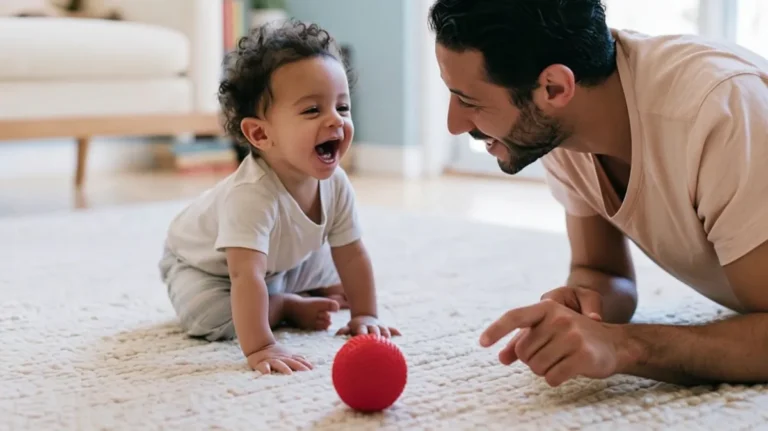
Listen. Mumble. Master.

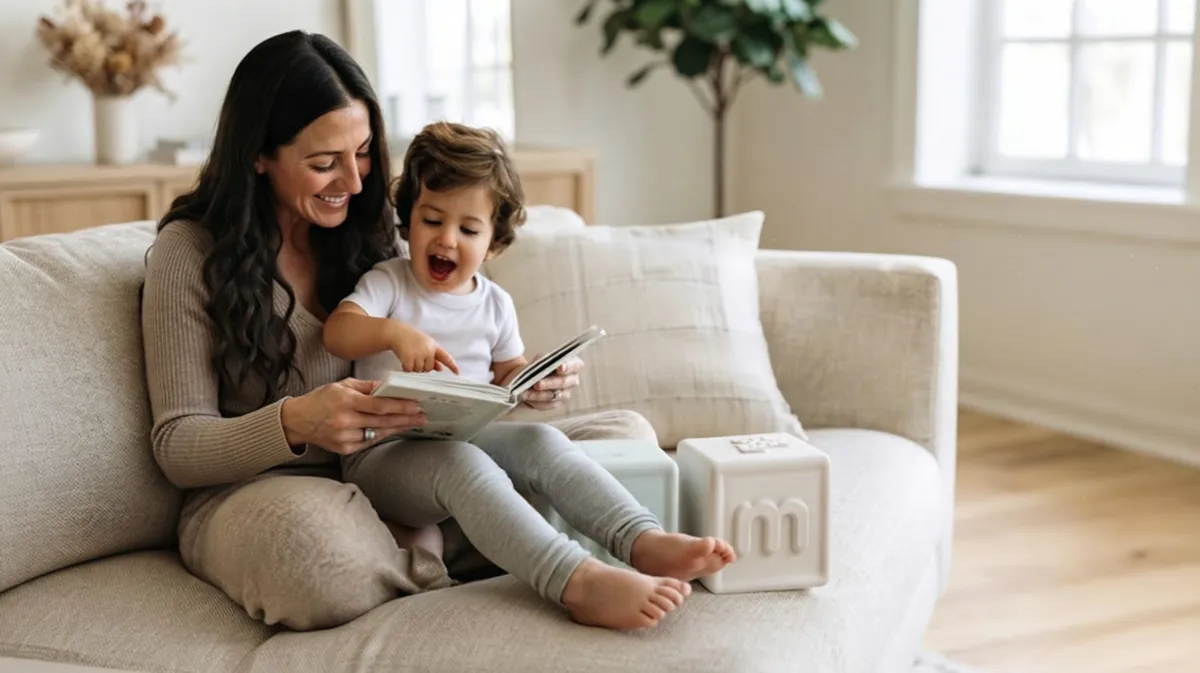
How Many Words Should an 18-Month-Old Say?
By 18 months, most toddlers try to say at least three words besides “mama” or “dada”, according to the CDC’s milestones. Many say more, and the range is wide: what matters most is that your toddler is steadily adding words, understanding simple directions and using gestures to communicate.
At the playground, another parent mentions that their 18-month-old “says about 40 words”. You smile, then quietly start counting on your fingers: “ball”, “more”, “uh-oh”, “dog”… and run out of fingers far too soon. It’s one of the most common worries in toddlerhood, and usually the comparison tells you much less than it seems.
This guide explains what the milestones really say, what counts as a word, the words most toddlers learn first, and when it’s worth asking a professional.
What the 18-month milestone means
The CDC updated its milestones in 2022 so that each one describes what most children, at least 3 out of 4, can do by that age (Understood). That’s why the 18-month milestone sounds small: “tries to say three or more words besides ‘mama’ or ‘dada'”. It’s a minimum most toddlers reach, not an average.
In real life, 18-month-olds vary enormously. Some say a handful of words; others say dozens. Both can be on track, because vocabulary at this age tends to grow in bursts rather than at a steady pace.
What counts as a word at 18 months?
More than you might think. Count it as a word when your toddler uses the same sound for the same thing, on purpose:
- Word attempts: “ba” for ball, “nana” for banana, “wawa” for water.
- Animal and object sounds: “moo”, “woof”, “vroom”.
- Little social words: “hi”, “bye”, “uh-oh”, “no”.
- Signs: a baby sign or gesture used consistently, like signing “more”.
When you count, include all of these. Many parents find their toddler says more words than they thought.
More than a word count: what to look for at 18 months
Words are only part of the picture. Understanding and gestures tell you just as much about how your toddler’s communication is growing.
| Area | What most toddlers do by 15–18 months (CDC) | Everyday example |
|---|---|---|
| Talking | Tries to say three or more words besides “mama” or “dada” | “Ball!”, “more”, “dog” |
| Understanding | Follows one-step directions without gestures | “Give me the cup” without you pointing |
| Understanding | Looks at a familiar object when it’s named | Turns to the dog when you say “Where’s the dog?” |
| Gestures | Points to ask for something or to get help | Points at the shelf for a snack |
Source: CDC milestones for 15 and 18 months, as summarized by Understood.
What comes next: 18 to 30 months
| Age | Typical next step |
|---|---|
| 18 months | At least three words besides “mama” and “dada” |
| 24 months | Puts at least two words together, like “more milk” (Understood) |
| 30 months | Says about 50 words and combines words with an action word, like “doggie run” (CDC) |
If your toddler is just getting started, our guide to when babies say their first word explains the earlier stages.
The 25 words most toddlers know first
Research by psychologist Leslie Rescorla found that a core set of everyday words shows up in the vocabularies of most 2-year-olds, whether they talk early or late, and studies in several countries have found similar lists (ABC News, on Rescorla’s research). They’re a great place to start at 18 months.
| Family | Food and drink | Animals and body | Things | Social and other |
|---|---|---|---|---|
| mommy | milk | dog | ball | hi/hello |
| daddy | juice | cat | shoe | bye-bye |
| baby | banana | nose | hat | thank you |
| cookie | eye | book | yes, no | |
| car, bath | more, all gone, hot |
7 ways to help your 18-month-old say more words
- Name what they point at. When your toddler points, give them the word: “Bird! A little bird.” Following their interest makes the word stick.
- Add one word. If they say “ball”, say “Big ball!” or “Throw ball!” You’re showing the next step, two words together, without asking them to repeat.
- Offer choices. “Milk or water?” puts both words right in front of them and makes saying one worth it.
- Use the same words every day. Routines like meals, baths and bedtime repeat the same words, and repetition is how toddlers learn.
- Read the same books again. Toddlers love repetition. Pause before a word they know and let them fill it in.
- Sing and pause. Stop just before the last word of a familiar line (“Twinkle, twinkle, little…”) and wait.
- Wait a little longer. After you ask a question, count to five in your head. Toddlers often need a few seconds to find a word.
For more simple games by age, see our guide to speech practice at home for toddlers.
What does “late talker” mean?
You may hear the term late talker. In Rescorla’s research, children are usually described as late talkers when they say fewer than 50 words at 24 months, not at 18 months. Many late talkers who have no other developmental or hearing concerns were talking within the normal range by about age 4 or 5 (ABC News, on Rescorla’s research).
That doesn’t mean waiting and hoping. Late talking can sometimes be linked to hearing problems or other developmental differences, which is why it’s worth checking early. Asking costs nothing, and if support is needed, starting early helps.
When to ask a professional
Every toddler grows at their own pace. It’s worth talking to your pediatrician if, by about 18 months, your toddler:
- isn’t trying at least three words besides “mama” or “dada”;
- doesn’t point to ask for things or show you something;
- doesn’t seem to understand simple words or directions;
- loses words or skills they used to have, at any age.
A hearing check is often a good first step. Your pediatrician can refer you to a speech-language pathologist, or you can find one through ASHA ProFind. Read more in our Speech Milestones guides.
Free printable: 25 first words checklist
The 25 most common early words on one page. Tick each one as your toddler says it, and add their own favorites. [Email signup form goes here.]
Video (60 seconds): [Embed your YouTube video here: “How to help your 18-month-old say more words”.]
Frequently asked questions
Is it normal for an 18-month-old to say only a few words?
It can be. The CDC milestone is three or more words besides “mama” and “dada”, and many toddlers who say only a few words at 18 months catch up quickly. Look at the bigger picture: understanding, pointing and steady progress.
How many words should an 18-month-old understand?
Toddlers understand far more words than they can say. At 18 months, most can follow a simple one-step direction like “bring me your shoes” without you pointing, and look at familiar things when you name them.
What if my 18-month-old understands but doesn’t talk?
Strong understanding is a good sign. Keep naming things, offering choices and pausing for them to try. If they aren’t trying at least a few words by 18 months, ask your pediatrician for a check.
Do boys talk later than girls?
On average, girls tend to say first words a little earlier, but the difference between individual children is much larger than the difference between boys and girls. Use the same milestones for every toddler.
When should my toddler start putting two words together?
The CDC milestone is by 24 months, with phrases like “more milk” or “daddy go”. You can help by adding one word to whatever your toddler says.
Conclusion
There’s no perfect number of words at 18 months. Three or more words besides “mama” and “dada” is the milestone, but the real signs are a toddler who understands you, points, tries new words and keeps growing. Name what they love, add one word at a time, and give them time to answer.
As your toddler gets closer to 2, Mumblet can make daily practice easy. Mumblecards are speech flashcards for toddlers and preschoolers ages 2 to 6: Mumblet the capybara says an everyday word, like many on the list above, and your toddler says it out loud. Each round ends after 10 cards.
Practice these words in Mumblet: free deck, no account.
Mumblet supports speech practice at home. It isn’t therapy and doesn’t diagnose anything. If you’re worried about your toddler’s speech or development, talk to your pediatrician or a speech-language pathologist.
Sources
- ASHA ProFind, find a speech-language pathologist
- Developmental milestones for 1-year-olds, Understood (summarizing the CDC milestones, including 15 and 18 months)
- Developmental milestones for 2-year-olds, Understood (summarizing the CDC milestones)
- Important Milestones: Your Baby by Thirty Months, Centers for Disease Control and Prevention
- The 25 words your toddler likely knows, ABC News, on research by Leslie Rescorla (2012)