Listen. Mumble. Master.

When Do Babies Say Their First Word? Age-by-Age Guide
Most babies say their first word around their first birthday, often “mama”, “dada” or a word for something they love, like “ba” for ball. But the normal range is wide: some babies start a little before 12 months, and many don’t say a clear word until 14 or 15 months.
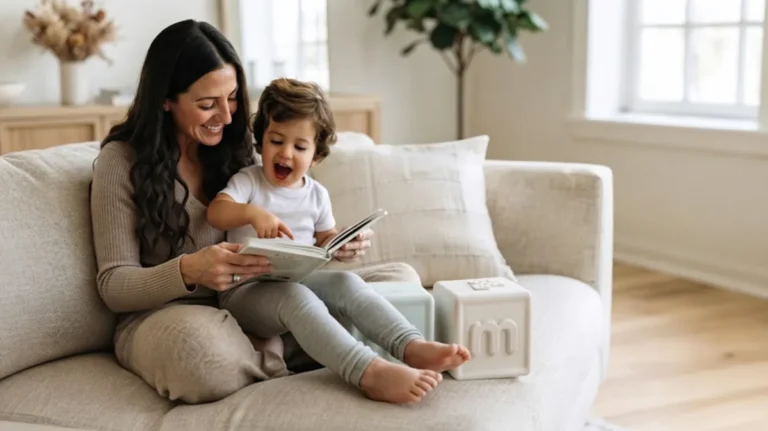
You’re holding your baby on your lap, reading the same board book for the tenth time. You point at the dog and say “dog” again. And then, out of nowhere, a small voice says “da!” Was that a word? You look at each other, then at the book. It might have been. And it’s the beginning of something big.
This guide walks you through what to expect, month by month, how wide the normal range really is, and simple ways to help those first words along.
What counts as a first word?
A first word doesn’t have to sound like the adult word. It counts when your baby uses the same sound for the same thing, on purpose, more than once. “Ba” every time they see a ball is a word. “Wawa” when they want water is a word. A sign or gesture used the same way, like waving for “bye-bye”, is also a real step in communication.
Babbling is different. Long strings like “bababa” or “dadada” are your baby practicing sounds, and they’re an important stage, but they aren’t yet linked to a meaning. The shift happens when a sound starts to mean something specific.
First words timeline: what to expect by age
The milestones from 12 months onward come from the CDC, which lists what most children (at least 75%) can do by each age (Understood, summarizing the CDC). Earlier stages come from research on babbling and early understanding.
| Age | What you may hear and see |
|---|---|
| 0–6 months | Cooing, gurgling, laughing and squealing; your baby turns toward voices |
| About 5–10 months | Babbling with real syllables, like “bababa” and “mamama” (Parenting Science) |
| 6–12 months | Understands more than they can say: may look at familiar people or objects when they’re named |
| 12 months | Waves bye-bye; calls a parent “mama”, “dada” or another special name; understands “no” |
| 15 months | Tries to say one or two words besides “mama” or “dada”; points to ask for something |
| 18 months | Tries to say three or more words besides “mama” or “dada”; follows simple one-step directions |
| 24 months | Puts at least two words together, like “more milk”; points to pictures in a book when asked (Understood) |
| 30 months | Says about 50 words; combines two or more words with an action word, like “doggie run” (CDC) |
How wide is “normal”?
Wider than most parents expect. Research summarized by Parenting Science shows how much babies vary (Parenting Science):
- In a large parent survey, up to 75% of babies were reported to say a first word by 10 months, while about 25% had no words at 12 months.
- In a study that recorded 44 babies at home, about half had no words yet at 12 months, and 7 didn’t say a first word until 15 months or later.
In other words, a baby with no words at their first birthday is very common. What matters more is the overall picture: babbling, understanding, pointing and connecting with you, and steady progress over the following months. Once words start, many toddlers move on to longer ones, the kind you’ll find in our multisyllabic word lists, between ages 3 and 6.
Common first words
Babies tend to name what matters most to them: the people they love, things they can play with or eat, and words that make something happen. Speech-language pathologists name mama, dada, car, more and ball among the most common first words (Expressable). Here are more words parents often hear early on:
| People | Things | Actions and social words | Sounds |
|---|---|---|---|
| mama, dada | ball, car | more, up | moo, woof |
| a sibling’s or pet’s name | dog, cat | hi, bye | uh-oh |
| baby | milk, ba(nana) | no, all done | vroom |
Don’t worry if your baby’s first word is “uh-oh” or “woof”. Animal sounds and little social words count, and they’re often easier to say than names of things.
6 ways to encourage your baby’s first words
Babies learn to talk through back-and-forth moments with the people who care for them. Research on parent coaching links face-to-face, turn-taking talk with stronger early language growth (Parenting Science). Here’s how to make the most of everyday moments:
- Talk face to face. Get down to your baby’s level so they can see your mouth and expressions. Babies watch lips closely as they learn sounds.
- Take turns. When your baby babbles, answer as if they said something important, then pause and let them “reply”. These little conversations are practice for real ones.
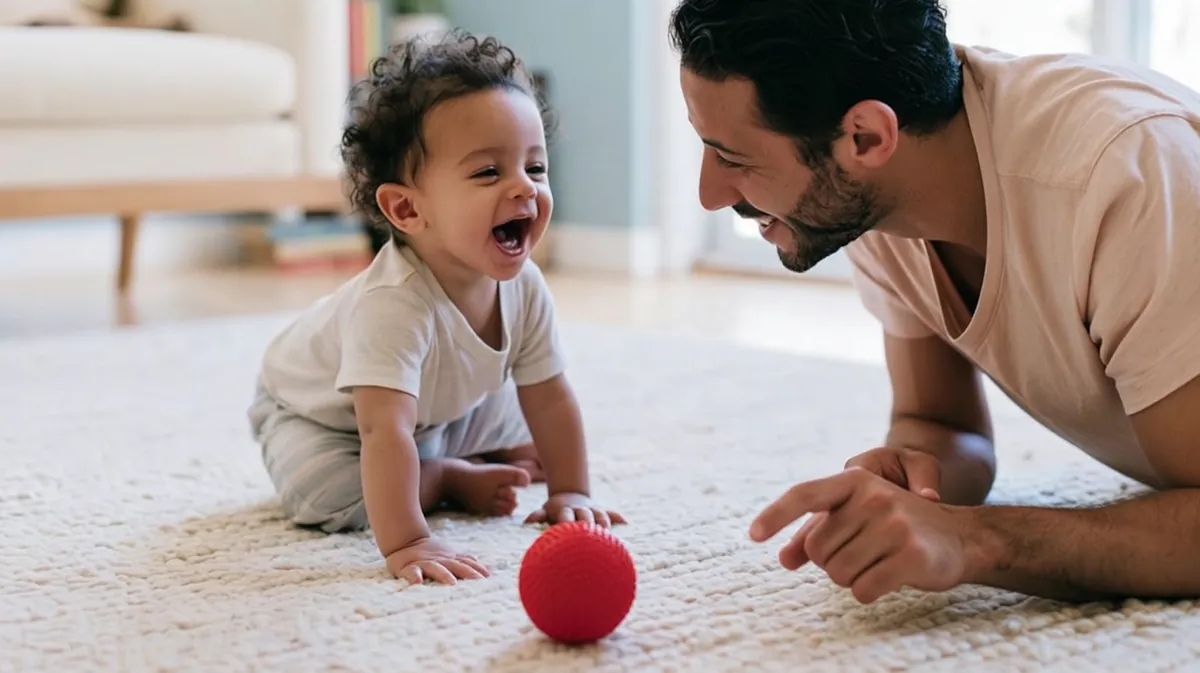
- Copy their sounds. If your baby says “ba”, say “ba” back, then add a word: “Ba! Ball!” Imitation shows them their sounds have power.
- Name what they look at. When your baby points or stares at something, say its name simply: “Dog. A big dog.” Following their interest makes the word easier to learn.
- Read and sing every day. Board books with simple pictures and songs with repeated words give your baby the same words again and again.
- Pause and wait. After a question or a familiar phrase, wait a few seconds with an expectant smile. Give your baby a chance to fill the silence.
Once your toddler starts putting words together, our guide to speech practice at home has simple games for ages 2 and up.
When to ask a professional
Every baby finds words at their own pace, and most late starters catch up. Still, it’s worth talking to your pediatrician if your baby:
- isn’t babbling with syllables like “ba” or “da” by about 9 to 10 months (Parenting Science);
- has no first word by about 15 months, or isn’t trying three or more words by 18 months (CDC milestones);
- rarely points, waves or responds to their name;
- loses words or skills they had before, at any age.
A hearing check is often the first step, since babies need to hear words clearly to learn them. Your pediatrician can also refer you to a speech-language pathologist, or you can find one through ASHA ProFind. Read more in our Speech Milestones guides.
Free printable: first words tracker
A one-page sheet to write down each new word, the date and what your baby meant. It’s lovely to keep, and useful to bring to checkups. [Email signup form goes here.]
Frequently asked questions
What is the average age for a baby’s first word?
Around 12 months, with a wide normal range. The CDC expects most babies to call a parent “mama” or “dada” by 12 months and to try one or two other words by 15 months.
Can babies say words before 12 months?
Yes. Some babies say a first word at 9 or 10 months, and a few even earlier. Early talking isn’t a sign of higher intelligence, and later talking isn’t a sign of a problem on its own.
Is “mama” or “dada” a real first word?
It counts when your baby uses it on purpose for a specific person. Before that, “mamama” and “dadada” are babbling, an important step on the way to words.
My baby is 12 months old and not talking. Should I worry?
Not necessarily. Many babies have no words at 12 months. Look at the bigger picture: babbling, pointing, waving and understanding simple words. If you’re unsure, ask your pediatrician; checking costs nothing and gives peace of mind.
How many words should a baby say by 18 months?
The CDC milestone is at least three words besides “mama” and “dada” by 18 months. Many toddlers say more, and vocabulary often grows quickly between 18 and 24 months.
Conclusion
Your baby’s first word will arrive in its own time, and the months before it are full of progress: every coo, babble and point is part of learning to talk. Talk face to face, take turns, name what they look at and read together every day. And if something feels off, trust your instincts and ask.
When your toddler turns 2 and words start coming faster, Mumblet can be a gentle next step. Mumblecards are speech flashcards for toddlers and preschoolers ages 2 to 6: Mumblet the capybara says an everyday word, your toddler says it out loud, and each round ends after 10 cards.
Practice these words in Mumblet: free deck, no account.
Mumblet supports speech practice at home. It isn’t therapy and doesn’t diagnose anything. If you’re worried about your child’s speech or development, talk to your pediatrician or a speech-language pathologist.
Sources
- ASHA ProFind, find a speech-language pathologist
- Developmental milestones for 1-year-olds, Understood (summarizing the CDC milestones)
- Developmental milestones for 2-year-olds, Understood (summarizing the CDC milestones)
- Important Milestones: Your Baby by Thirty Months, Centers for Disease Control and Prevention
- When do babies say their first word?, Parenting Science (summary of research on babbling, first words and variation)
- When do babies start talking?, Expressable (reviewed by a speech-language pathologist)