
Listen. Mumble. Master.


Speech Practice at Home for Toddlers: 5 Minutes a Day
The best speech practice at home for toddlers is short, daily and woven into things you already do: a few minutes of talking, repeating and adding words during meals, baths and play. You don’t need special training or equipment, just the habits speech-language experts recommend, done with your toddler beside you.
Picture breakfast on a busy morning. Your 2-year-old points at the banana and says “nana”. You smile, hand it over and say, “Banana! A yellow banana.” That small moment, about three seconds long, is speech practice. It’s the kind your toddler learns from most.
Why speech practice at home matters
If you’re reading this, you’ve probably wondered whether your toddler is talking enough, or clearly enough. You’re not alone, and you’re not overreacting. According to the National Institute on Deafness and Other Communication Disorders, about 1 in 14 children ages 3 to 17 (7.2%) had a voice, speech or language disorder in the past year, and an estimated 8 to 9% of young children have a speech sound disorder. These are the most recent national figures available, based on 2012 data. (NIDCD)
Most toddlers who talk a little later or a little less clearly catch up with time and support. Either way, what happens at home matters. Children learn to talk through thousands of small, back-and-forth moments with the people who love them. Home is where most of those moments happen, which makes you their most important teacher, whether or not they ever need a speech-language pathologist.
The good news: you don’t need an hour a day. You need the right habits, a few simple games for your toddler’s age, and five focused minutes.
The 4 habits behind every speech activity
Every game in this guide works because of four simple habits, all drawn from the American Speech-Language-Hearing Association’s tips for parents (ASHA). Get these right and almost any moment becomes practice.
1. Talk about what you’re doing
Describe your day out loud, in short sentences: “I’m cutting the apple. Crunch! Now it’s in two pieces.” Toddlers learn words by hearing them linked to what they see. You don’t need to quiz them; just give them the words.
2. Repeat and expand
When your toddler says a word, say it back clearly, then add one more word. If they say “juice”, you say “Apple juice!” If they say “dog run”, you say “Yes, the dog is running fast!” ASHA calls this expanding. It shows you understood and gives them the next step without correcting them.
3. Offer choices
Instead of “Do you want a snack?” (which invites a nod), ask “Banana or crackers?” A choice puts the words right in front of your toddler and makes saying one of them worth it.
4. Slow down and wait
This is the hardest one for busy parents. After you ask a question or start a sentence, pause and count to five in your head. Many toddlers need a few extra seconds to find a word. If you fill the silence too fast, they never get to try.
| Habit | Instead of | Try |
|---|---|---|
| Talk about it | Silence while you cook | “Stir, stir, stir. The soup is hot.” |
| Repeat and expand | “Say ‘ball’ properly.” | “Ball! A big red ball.” |
| Offer choices | “Want a drink?” | “Milk or water?” |
| Wait | Answering for them | Pause, smile, count to five |
Speech activities for 2- to 3-year-olds: first words
At this age, the goal is more words and more tries, not perfect sounds. If your toddler says “wa-wa” for water, that’s a win. Choose short, everyday words of one or two syllables, like ball, cup, dog, more, up, milk, shoe and bath. Looking for more ideas? Our Mumblecards word lists group first words by category, from animals to food.
1. Animal sounds
Hold up a toy animal or point to one in a book and make its sound: “The cow says moo.” Then pause and look at your toddler expectantly. Animal sounds are often easier to say than real words, and they’re a natural first step toward naming. Once they say “moo”, add the name: “Moo! Cow!”
2. The object box
Put four or five familiar things in a box or bag: a spoon, a sock, a small car, a cup. Take turns pulling one out and naming it. ASHA suggests this game for ages 2 to 4 (ASHA). Keep the objects big enough that they can’t be swallowed.
3. Bath-time naming
Bath time is ideal: your toddler is close, relaxed and in no hurry. Name body parts as you wash them (“Wash your toes. Ten toes!”) and toys as they float by. Repeat the same words every night; repetition is how words stick.
4. Snack-time choices
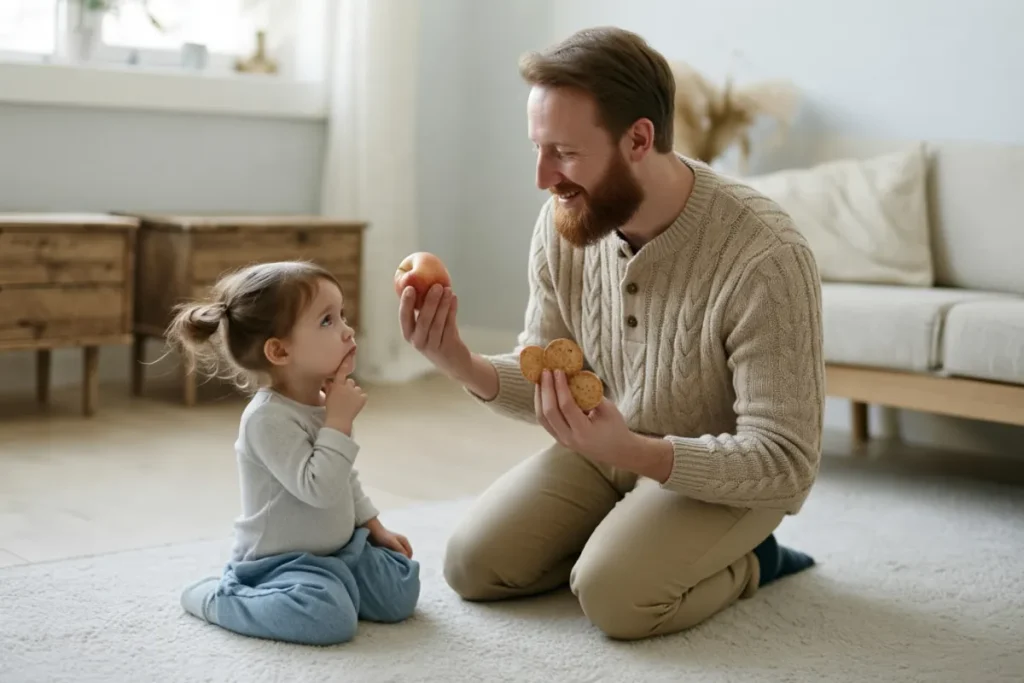
Offer two snacks and hold them up: “Apple or cheese?” Wait. If your toddler points, model the word (“Cheese!”) and wait a moment longer before you hand it over. Any attempt, even “chee”, earns the snack. You’re teaching that words work.
5. Songs with pauses
Sing a song your toddler knows well, such as “Old MacDonald” or “Twinkle, Twinkle”, and stop just before a familiar word: “Twinkle, twinkle, little…” Then wait. Filling in the gap is a joyful, low-pressure way to say a word, and the rhythm of songs helps with the rhythm of speech.
Speech activities for 4- to 6-year-olds: clear words
By 4 to 6, most children have plenty of words. The worries shift to clarity: sounds that get mixed up, longer words that come out jumbled, or speech so fast it runs together. The goal now is clear words, said at a steady pace. Good practice words have two to four syllables, like rabbit, pizza, banana, butterfly, helicopter and lemonade.
1. Syllable clapping
Say a word slowly and clap once for each part: “but-ter-fly” is three claps. Then let your child clap and say it with you. Clapping helps children hear every part of a long word, so fewer parts get dropped. Start with names (“Ma-ri-a”) and favorite foods.
2. Say it like a turtle
If your child rushes, turn slow talking into a game. Pretend to be turtles and say a word as slowly as you can: “Heeel-iii-cop-ter.” Then try it at normal speed. Children who talk fast often can say the sounds; they just need time to fit them all in. The turtle makes slowing down fun instead of a correction.
3. Silly pictures
ASHA suggests mixing and matching pictures (a dog wearing a hat, a fish in a tree) and talking about what’s wrong and how to fix it (ASHA). Your child practices longer sentences and describing words while laughing, which keeps practice light.
4. Category sort
Cut out pictures or use toys and sort them into groups: things we eat, things we ride, things we wear. Ask your child to name each one as it goes into its pile. Sorting builds vocabulary and gives you many chances to hear words said clearly.
5. Photo storytelling
Use photos of family, trips or your neighborhood and make up a story together: “Who’s this? Where are they going?” Telling a story asks children to put words in order, use describing words and speak in full sentences, all skills they’ll need at school.
| Age | Main goal | Example words |
|---|---|---|
| 2–3 years | More words, more tries | ball, cup, dog, more, up, milk |
| 3–4 years | Two-syllable words, steady pace | apple, water, rabbit, pizza, balloon |
| 4–6 years | Clear, longer words | banana, butterfly, helicopter, lemonade |
A 5-minute daily speech routine
You don’t need a separate “speech time”. Spread a few minutes across moments you already share. Pick two or three of these each day and keep them light.
| Time of day | Activity | About | Example words |
|---|---|---|---|
| Breakfast | Snack-time choices | 1 minute | banana, milk, more, spoon |
| Getting dressed | Name and describe | 1 minute | shoe, sock, hat, blue, big |
| Play time | Object box or animal sounds (2–3); category sort (4–6) | 1 to 2 minutes | car, cow, duck, apple, train |
| Bath | Bath-time naming | 1 minute | toes, nose, bubbles, duck, wet |
| Bedtime | Book with a pause, or a song with a missing word | 1 minute | star, moon, sleep, night |
The rule of thumb: stop while it’s still fun. Five happy minutes spread across the day do more than twenty minutes that end in tears.
Safety tips for speech games
- Small objects: for the object box and sorting games, use items larger than your toddler’s mouth, and put them away afterward.
- Bubbles and blowing games: supervise closely so bubble solution isn’t swallowed, and skip feathers and cotton balls for children who still put things in their mouth.
- Cut-out pictures: use thick card and child-safe scissors, and keep them out of reach when you’re done.
When to ask a professional
Every toddler finds words at their own pace, but it’s worth talking to your pediatrician or a speech-language pathologist if, by about 30 months, your toddler doesn’t yet:
- say around 50 words;
- put two or more words together, including an action word, like “doggie run”;
- use words like “I”, “me” or “we”.
These milestones come from the CDC. Trust your instincts too: if something feels off at any age, ask. You can find a speech-language pathologist near you through ASHA ProFind, and read more in our Speech Milestones guides.
Free printable: your 5-minute word practice plan
A one-page plan with the daily routine above, word ideas by age and the four habits, ready to stick on your fridge. [Email signup form goes here.]
Frequently asked questions
How long should speech practice take each day?
About five minutes, spread across the day, is a good start. Short, frequent moments during meals, baths and play work better for toddlers than one long session.
How long should speech practice take each day?
About five minutes, spread across the day, is a good start. Short, frequent moments during meals, baths and play work better for toddlers than one long session.
What if my toddler won’t repeat words?
That’s very common. Don’t ask them to repeat; model the word, wait a few seconds and move on. Toddlers often say a new word days after first hearing it, once it feels safe to try.
Do screens help or hurt toddler speech?
It depends on how they’re used. Toddlers learn words through back-and-forth with a person, so watching alone does little for speech. Short, active screen time that asks your child to talk, with you beside them, is a better fit. Our guide to low-stimulation screen time explains what to look for.
What words should my toddler practice first?
Start with words they hear and want every day: people (mama, dada), food (milk, banana), toys (ball, car), actions (up, go, more) and animals (dog, cat). Words that get them something they want are the most motivating.
Conclusion
Helping your toddler talk doesn’t take a perfect plan. It takes the four habits (talk about what you’re doing, repeat and expand, offer choices and wait), a few games that fit their age, and five minutes of your attention each day. Every word starts as a mumble, and every time you say it back, it gets a little clearer.
If you’d like a ready-made way to practice, Mumblet can help. Mumblecards are speech flashcards for toddlers ages 2 to 6: Mumblet the capybara says a word, your toddler says it out loud, and each round ends after 10 cards. The first deck is free.
Practice these words in Mumblet: free deck, no account.
Mumblet supports speech practice at home. It isn’t therapy and doesn’t diagnose anything. If you’re worried about your toddler’s speech or development, talk to your pediatrician or a speech-language pathologist.
Sources
ASHA ProFind, find a speech-language pathologist
Activities to Encourage Speech and Language Development, American Speech-Language-Hearing Association
Quick Statistics About Voice, Speech, Language, National Institute on Deafness and Other Communication Disorders (2012 data)
Important Milestones: Your Baby by Thirty Months, Centers for Disease Control and Prevention